
What if the biggest threat to your school isn't budget cuts or staff shortages, but clinging to a version of education the world has already moved past?
Education 5.0 isn't a buzzword. It's a fundamental shift in what schools are for, and administrators who understand it early will be the ones shaping the next decade of learning, not scrambling to catch up.
What Is Education 5.0 and Why Should School Leaders Pay Attention?
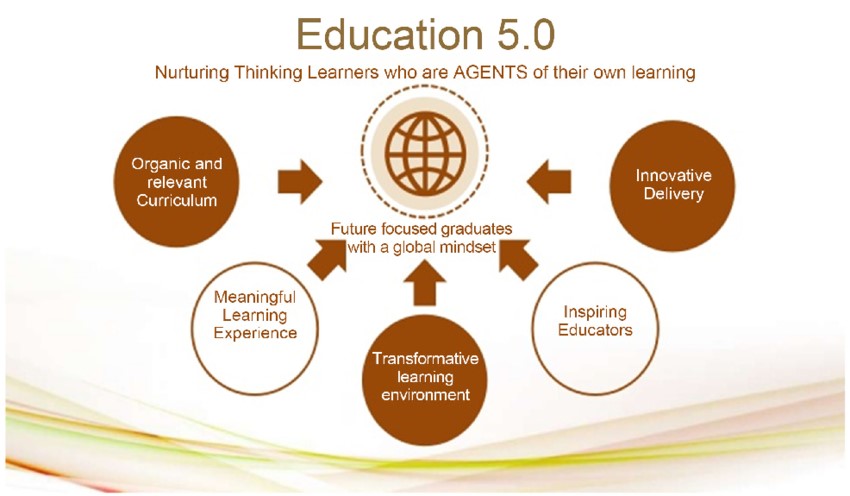
Education 5.0 builds on the foundation of Industry 5.0 — the global movement that brings human values back to the center of technological progress. Where Education 4.0 was largely about digitizing classrooms and integrating EdTech, Education 5.0 goes further. It asks a harder question: Are we developing human beings, or just producing graduates?
At its core, Education 5.0 is about the convergence of human intelligence and artificial intelligence, personalized learning at scale, sustainability thinking, and — crucially — the emotional and ethical development of every student. It positions schools not as knowledge delivery systems, but as ecosystems where curiosity, critical thinking, empathy, and adaptability are actively cultivated.
For school administrators, this isn't a curriculum update. It's a leadership challenge.
How Education 5.0 Changes the Role of School Administrators
In traditional school management, administrators focused on compliance, timetabling, staffing, and performance metrics. Education 5.0 demands something different: systems thinking.
A school leader operating in an Education 5.0 context must now consider:
- How Learning is Designed, Not Just Delivered?
Administrators need to understand pedagogy deeply enough to drive meaningful change, not just approve lesson plans. This requires school leaders to engage with learning design as a strategic function, not a teacher-only concern.
- How is Data Used Ethically?
With AI-powered platforms generating vast amounts of student data, administrators must build governance frameworks that protect student privacy while leveraging insights to improve outcomes.
- How Well-Being Connects to Performance?
Research from OECD and UNESCO consistently shows that student wellbeing and academic achievement are not in competition, they are interdependent. School management systems in an Education 5.0 framework reflect this by design.
- How Teachers Are Developed, Not Just Managed
The shift from teacher management to teacher development is one of the clearest signals of Education 5.0 in practice. Schools that thrive will be the ones where professional learning is continuous, contextual, and tied directly to classroom impact.
5 Pillars of Education 5.0 Every School Administrator Must Understand
To translate Education 5.0 from concept to action, school leaders need a clear framework. Here are five pillars that define this era in practical terms:
1. Human-Centered Technology Integration
Technology in an Education 5.0 school serves the learner, it does not replace the teacher. Administrators must audit their current EdTech not just for functionality, but for alignment with learning outcomes. The question is no longer "Do we have the tools?" but "Are the tools making learning more human?"
2. Competency-Based and Personalized Learning Pathways
One-size-fits-all instruction is incompatible with Education 5.0. School systems must shift toward flexible pathways that recognize diverse learning needs, cultural contexts, and individual pacing. This has direct implications for how administrators structure timetables, assessments, and teacher workloads.
3. Sustainability and Global Citizenship Education
Education 5.0 is inseparable from global responsibility. Schools are increasingly expected to embed sustainability, environmental, social, and economic issues into the fabric of learning. This isn't an add-on subject, it's a schoolwide ethos that begins in leadership.
4. Teacher Professional Development as a Strategic Investment
Schools that treat teacher training as a cost rather than an investment will struggle to compete. Education 5.0 demands that teachers are equipped not just with subject knowledge, but with skills in learning design, data literacy, and adaptive teaching. Administrators who prioritize this will see the returns in retention, morale, and student outcomes.
5. Inclusive and Emotionally Intelligent School Cultures
Inclusion in Education 5.0 goes beyond physical accessibility. It means building environments where every student, regardless of background, ability, or learning style, feels genuinely seen. This requires administrators to lead with emotional intelligence and to model the culture they want to embed.
What Education 5.0 Means for Teacher Development — And Why Administrators Must Lead This Conversation
Here's where many schools get stuck: they understand that Education 5.0 requires better-prepared teachers, but they treat professional development as an HR function rather than a leadership priority.
In reality, the quality of teacher development is the most controllable lever school administrators have.
Globally, forward-thinking educators are pursuing deeper qualifications that bridge leadership, learning science, and organizational development. An MA education with L&D specialization, for example, equips educators and school leaders with a sophisticated understanding of how adults learn, how organizations change, and how to design learning environments, not just deliver content. This kind of qualification is increasingly relevant for administrators who want to lead Education 5.0 transitions with credibility and depth.
The shift is also driving demand for flexible, globally accessible learning. School leaders across Asia, Africa, the Middle East, and beyond are turning to an online MA in Education Learning and Development to upskill without stepping away from their schools. The ability to study while leading is no longer a luxury, it's a practical necessity for administrators who need to grow in real time, alongside their institutions.
Practical Steps School Administrators Can Take Right Now to Prepare for Education 5.0
Understanding Education 5.0 is one thing. Embedding it in your school is another. Here's where to start:
1. Audit Your Current Reality Honestly
Before you can move forward, you need to know where you actually stand. Survey your teachers, review your curriculum frameworks, and assess your technology use against Education 5.0 principles. Be honest about the gaps.
2. Build a Shared Vision With Your Team
Education 5.0 cannot be mandated from the top. It must be co-created. Bring your leadership team and teaching staff into the conversation early. Schools that are furthest ahead in this transition are those where teachers feel like architects, not just implementers.
3. Redesign Professional Learning Structures
Move away from one-off training days toward sustained, collaborative professional learning communities. Connect teacher development to real classroom challenges and give educators time to reflect, experiment, and share.
3. Engage with Global Frameworks and Research
Education 5.0 is a global conversation. School leaders who engage with international research, from UNESCO's frameworks on futures of education to OECD's Learning Compass 2030, bring a broader, more credible perspective to local decision-making.
4. Invest in Your Own Development. The most important thing an administrator can do is model the growth mindset they want to see in their school. Leaders who pursue formal qualifications, engage with global learning communities, and stay genuinely curious about education's evolution are the ones who inspire the same in others.
Common Mistakes Schools Make When Responding to Education 5.0
Not every school that says it's embracing Education 5.0 actually is. Here are the pitfalls to watch for:
- Mistaking Technology for Transformation
Buying tablets and installing AI tutoring platforms does not make a school Education 5.0-ready. Technology is an enabler, not the destination. Without clear pedagogical thinking behind it, EdTech becomes expensive furniture.
- Treating It As a Project, Not a Process
Education 5.0 is not a strategic plan with a completion date. It's an ongoing orientation toward what education can and should be. Schools that treat it as a one-year initiative will find themselves back at square one.
- Leaving Teachers Behind
The most sophisticated Education 5.0 vision will fail if teachers don't understand it, believe in it, or have the skills to enact it. Teacher buy-in is not optional, it's foundational.
- Ignoring Local Context
Education 5.0 is global in its principles but must be local in its application. What works in Singapore may not translate directly to schools in Nigeria or Colombia. Administrators must adapt frameworks thoughtfully, not copy them blindly.
The Bottom Line
Education 5.0 is not a future scenario, it's the present reality that the most effective schools are already navigating. For administrators, the question isn't whether to respond, but how quickly and how thoughtfully.
The leaders who will shape Education 5.0 schools are those who invest in understanding learning at a deeper level, whether through formal study, such as pursuing an International Education and Training qualification, or through sustained engagement with global education communities and research.
The schools that will thrive are not necessarily the ones with the most resources. They will be the ones with the clearest vision, the most intentional leadership, and the deepest commitment to growing the humans inside their walls, students and teachers alike.
Education 5.0 puts that responsibility squarely where it belongs: with you.
Frequently Asked Questions (FAQs)
1. What is Education 5.0?
Education 5.0 is a modern approach that combines human intelligence with technology, focusing on personalized learning, emotional development, and real-world skills.
2. How is Education 5.0 different from Education 4.0?
While Education 4.0 focused on digital transformation, Education 5.0 emphasizes human-centered learning, ethical use of technology, and holistic student development.
3. Why is Education 5.0 important for school administrators?
It shifts the role of administrators from managing operations to leading learning design, teacher development, and strategic school transformation.
4. How can schools prepare for Education 5.0?
Schools can start by redesigning professional development, integrating ethical technology use, and building inclusive, student-centered learning environments.
5. What qualifications help administrators adapt to Education 5.0?
Programs like online MA in education Learning and Development and International Education and Training qualification help leaders build the skills needed for modern school management.