
Performance management is an important ritual that must be practiced in every organization. Educational institutions, financial sectors, IT departments, management sectors, etc., should have a scope of performance management. This process is developmental that supports everyone to analyze how they’re performing and based on that the next steps are determined.
In the education sector, performance management for education plays a crucial role in improving institutional quality, teaching standards, and student outcomes. Teachers or other educational professionals who have completed courses in Education Management or Diploma in Education Administration and Management are well aware of how to demonstrate their skill sets in front of the whole class.
In fact, during an ongoing performance management session, teachers demonstrate how they contribute themselves towards teaching the learners. Teachers also give projections on how they are planning to execute better strategies so that the learning and progress curve of students accelerates smoothly. This is where education performance management becomes highly important, as it helps institutions understand both teacher effectiveness and learner progress.
There are 5 dimensions of performance management that help to determine future steps and analyze past performances as well. Those dimensions are Strategy, System, Tools, Indicators, and Scorecard. These 5 traits form a cycle that is never-ending and if utilized properly will ensure the achievement of strategic goals along with personal growth.
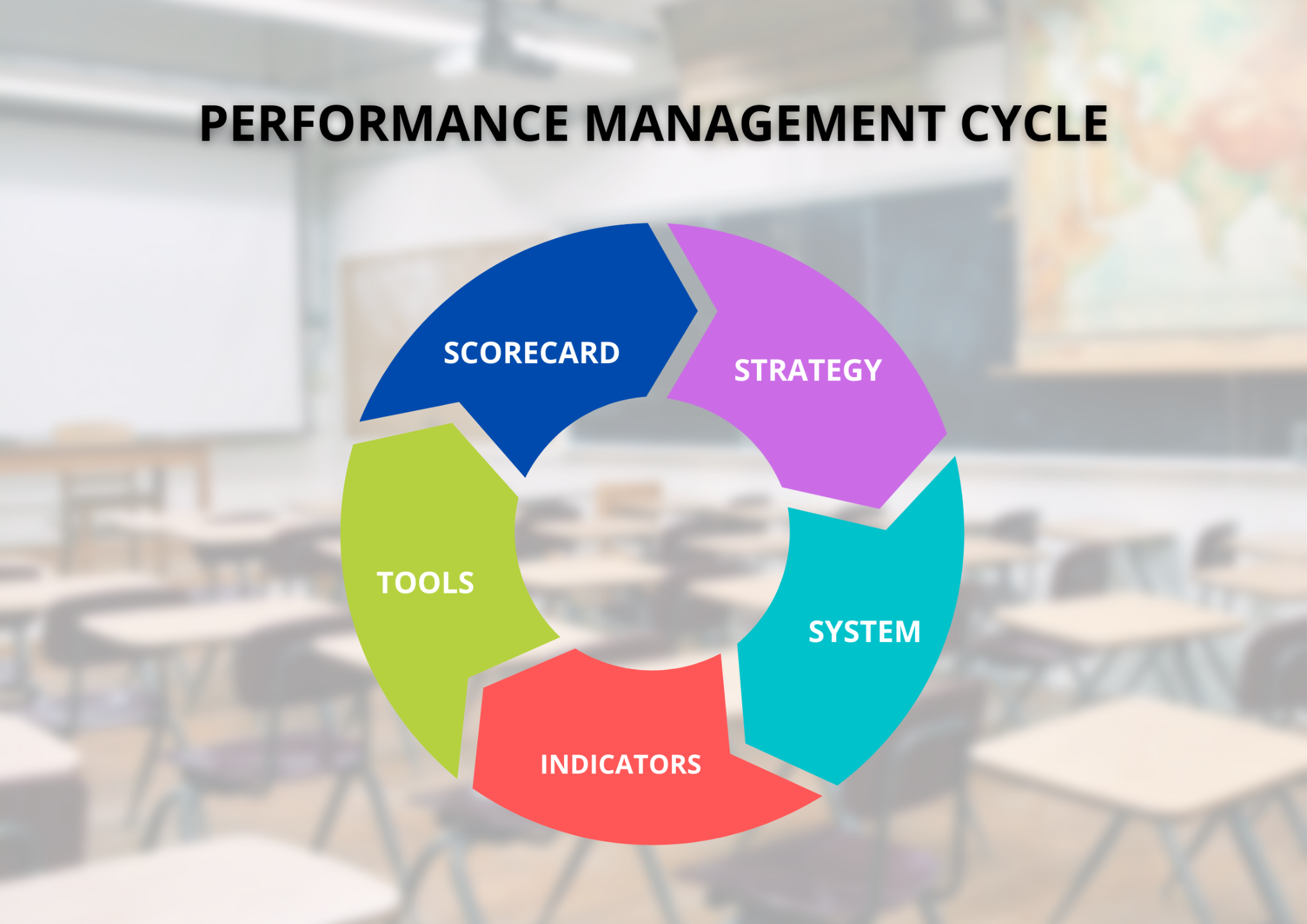
STRATEGY: Every strategy begins and ends with one question, What is the target? Being an educational administrator or a teacher, it should be well known to then how to achieve the target. In order to achieve the target, accurate strategies must be planned and executed. In the case of teachers, their goals revolve around how to improve their teaching skills and also to look after the progress rate of the students. A strong performance management strategy in education helps institutions align teacher development, student learning, and school objectives more effectively.
SYSTEM: Educational systems are getting upgraded every day. Schools are using modern technologies and updated curriculum to provide the best education to the learners. 21st-century teaching methodologies are being used and many schools are going for audio-visual techniques where students get opportunities to learn more.
TOOLS: Performance management of teachers includes their knowledge and skillsets. Their proficiency in tools and software is also of utter importance. Since online education is becoming a new normal, teachers should have the skills of conducting classes online over online platforms.
INDICATORS: As simple as the term says indicators indicate the path of measuring progress. Over hare, the progress rate of teachers is estimated where past performances of teachers are taken into account. Moreover, they are asked to formulate strategies or plans that they want to execute in the future to ensure better delivery of lectures.
SCORECARD: This depends upon various parameters like how teachers are teaching, how well they are covering the topics and the way they are catering to the needs of the students. Besides, feedback from parents and students is taken into consideration. A teacher performance scorecard can help school leaders track these areas more systematically and identify where improvement or support is needed.
Tips for effective performance management:
• Structured meetings throughout the entire year
• Clean communication among each other
• Data collection and utilization must be done accurately
• The objectives of the school must be clear
• There should not be any hidden conversations
Therefore, courses in Educational Management will guide you properly to understand how a school performs and how performance management is tracked. The feedback system should be clear, and data analysis must be done correctly to avoid any errors. Understanding the benefits of performance management in schools helps educators and administrators create a more transparent, supportive, and result-oriented academic environment.
Frequently Asked Questions (FAQs)
1. What is performance management in education?
Performance management in education is a structured process used by schools, colleges, and universities to assess teacher performance, student progress, institutional goals, and overall academic improvement.
2. Why is performance management important in schools?
Performance management is important because it helps schools identify strengths, address gaps, improve teaching quality, support student learning, and align staff performance with institutional objectives.
3. What are the benefits of performance management in schools?
The benefits of performance management in schools include better teacher development, clearer communication, improved student outcomes, data-driven planning, stronger accountability, and more effective institutional growth.
4. What are the main dimensions of education performance management?
The main dimensions include strategy, system, tools, indicators, and scorecard. Together, these help schools plan goals, track progress, measure performance, and decide future improvement steps.
5. What is a teacher performance scorecard?
A teacher performance scorecard is a tool used to evaluate teaching quality based on factors such as lesson delivery, student engagement, syllabus coverage, classroom management, feedback, and learner progress.
6. How does performance management help teachers?
Performance management helps teachers understand their strengths, improve weak areas, set professional goals, receive constructive feedback, and plan better teaching strategies for student success.
7. What makes a good performance management strategy in education?
A strong performance management strategy in education includes clear goals, regular reviews, transparent communication, accurate data collection, meaningful feedback, and actionable improvement plans.