

The training day went perfectly.
The speaker was engaging. Teachers gave top scores on the feedback forms. Many said it was the most useful session they had attended in years.
Two weeks later, classrooms looked exactly the same as before.
If you work in a school, college, or teacher training, you may have seen this happen. It is rarely the trainer’s fault. The real problem is usually how the training was planned and what happens after it ends. Understanding this is a key part of what a Master of Arts in Education with Learning & Development teaches.
Let’s look at why good teacher training often fails to change teaching, and what research says actually works.
Why Teacher Professional Development Often Fails to Change Classroom Practice
Enjoying a training session and applying it in a classroom are two different things.
The Kirkpatrick model, widely used to evaluate training, separates results into four levels. Here is how they translate to a school setting:
| Level | What it measures | Example in a school |
|---|---|---|
| 1. Reaction | How staff felt about the session | Feedback forms |
| 2. Learning | What staff understood | Short quiz or discussion |
| 3. Behaviour | Whether teaching practice changed | Lesson observation, learning walks |
| 4. Results | Impact on the school and learners | Student progress and engagement |
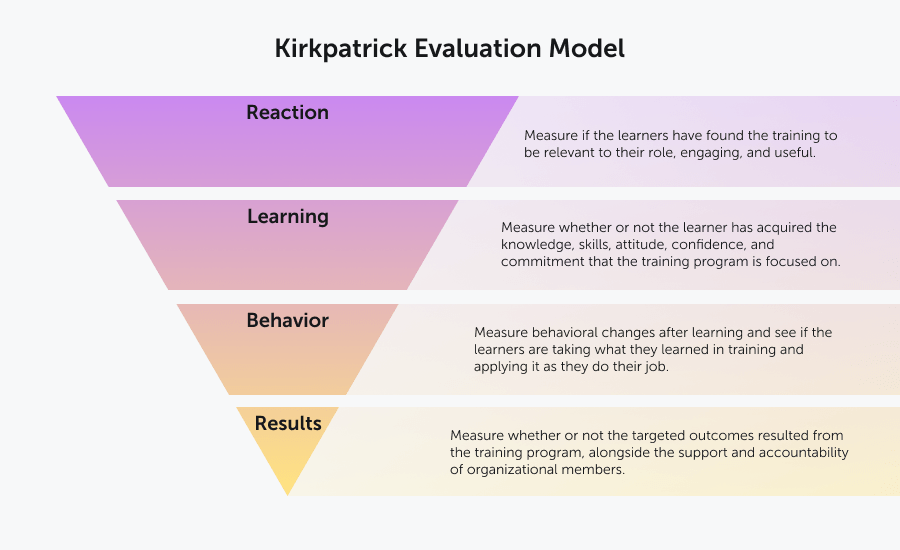
Source: valamis.com
Most schools measure levels 1 and 2 because they are easy to collect. The real test is level 3, and that is where many programmes quietly stall.
What Is Transfer of Training and Why Does It Fail in Schools?
The term for applying learning back in the workplace is transfer of training.
A well-known review by Baldwin and Ford, published in Personnel Psychology in 1988, grouped the factors that influence transfer into three areas:
- Learner Characteristics: Motivation, Confidence, and Ability
- Training Design: Relevance, Practice, and Clear goals
- Work Environment: Support from leaders and colleagues, and the opportunity to use the new skill
Only one of the three sits inside the training room.
In a school, the work environment includes timetables, workload, assessment expectations, department culture, and whether a new approach is backed by line managers. A strong session can still fail if those conditions work against it.
Common Reasons Teacher Training Does Not Change What Happens in the Classroom
These patterns appear again and again:
- A One-off Event: A single session with no follow-up gives new ideas little chance of becoming habit.
- No Chance to Practise: Teachers hear about a strategy but never rehearse it with feedback.
- Too Many Ideas at Once: Staff leave with a long list and apply none of it.
- Weak Link to Real Priorities: The topic was available, not selected because of an identified need in the school.
- Leaders Not Involved: Line managers did not attend, brief staff beforehand, or ask about it afterwards.
- Conflicting Demands: Existing routines, workload, or assessment pressures leave no room for the new approach.
- Forgetting: Research dating back to Hermann Ebbinghaus in the 1880s showed that new material fades quickly without review and use.
One of these can undo a good session. Often several are present together.
Is It Really a Training Problem? Diagnosing the Gap First
Before commissioning any professional development, it helps to ask an uncomfortable question.
Is this actually a skills problem?
Robert Mager and Peter Pipe, in their book Analyzing Performance Problems, argued that training only solves problems caused by a lack of knowledge or skill. If people already know what to do and are not doing it, more training is unlikely to help.
In schools, useful diagnostic questions include:
- Do teachers know how to do this?
- Do they have the time, resources, and authority to do it?
- Is the expected practice clear and consistently supported?
- Do competing priorities make the new approach unrealistic?
When the answers point to unclear expectations or structural barriers, the solution sits outside the training room.
What Research Says Effective Teacher Professional Development Looks Like
There is a substantial body of research on this question, and its conclusions point in the same direction.
A review by Darling-Hammond, Hyler, and Gardner for the Learning Policy Institute (2017) examined 35 rigorous studies and identified seven features shared by effective professional development:
- Focus on specific subject or teaching content
- Active learning rather than passive listening
- Collaboration among teachers
- Models of effective practice
- Coaching and expert support
- Time for feedback and reflection
- Sustained duration
The Education Endowment Foundation’s 2021 guidance on effective professional development, informed by a systematic review led by Sims and colleagues, groups the evidence into four areas: building knowledge, motivating staff, developing teaching techniques, and embedding practice. The EEF says that including at least one mechanism from each area makes it more likely that new practice becomes part of everyday teaching.
Earlier work by Joyce and Showers, (summarised here), found that training combining theory, demonstration, practice, and feedback was far more likely to change classroom practice when follow-up coaching was added.
The pattern is clear. Information alone rarely changes practice. Support over time does.
How School Leaders and Instructional Coaches Make Training Stick
Few factors matter more, and few are more overlooked.
When a teacher returns from training to a leader who never mentions it, the message is that it did not matter.
Leaders and coaches can shape transfer in practical ways:
- Agree on a specific focus with the teacher before the training
- Protect time for the new approach to be tried
- Observe and give feedback in a supportive, developmental way
- Create space for colleagues to share what is working
- Recognise progress when new practice appears
This also connects to how change actually happens. Thomas Guskey’s research on teacher change suggests that shifts in teachers’ beliefs often follow, rather than precede, evidence that a new approach is improving student learning. In other words, teachers need to see it work. That is why early, small wins and good feedback matter so much.
How to Design Professional Development That Changes Teaching Practice
Transfer can be planned for. It rarely happens by accident.
Before The Session
- Identify the specific teaching practices that need to develop
- Link the focus to a real, evidenced need in the school
- Brief leaders and line managers on their role
During The Session
- Teach fewer ideas, in more depth
- Use realistic classroom scenarios
- Model the practice, then let teachers rehearse it
- Ask each teacher to leave with one concrete action
After The Session
- Schedule short follow-up sessions across the term
- Pair teachers for peer observation or coaching
- Provide simple tools such as checklists or planning templates
- Revisit action points at regular intervals
Spacing learning over time, rather than delivering it in one block, is well supported by research on memory and is one of the simplest changes a designer can make.
How to Measure Whether Teaching Practice Has Actually Changed
If you cannot see a change in practice, you cannot say the training worked.
Thomas Guskey proposed evaluating professional development at five levels: participants’ reactions, participants’ learning, organisational support, use of new knowledge and skills, and student learning outcomes. This is a useful reminder that evaluation should reach beyond the feedback form.
Practical methods include:
- Lesson observations or learning walks focused on the target practice
- Short check-ins with participants some weeks after the session
- Review of planning documents or student work
- Teacher and student feedback
- Tracking agreed indicators linked to the original goal
The key is deciding what success looks like before the training begins.
The Skills Learning and Development Professionals in Education Need
Closing the gap between training and practice takes more than good facilitation.
It draws on skills such as:
- Needs analysis and performance diagnosis
- Designing learning for adults, in person and online
- Understanding how teachers learn and change practice
- Evaluation methods that go beyond satisfaction surveys
- Working with school leaders to shape supportive conditions
- Using research evidence to inform design decisions
An MA in Education with Learning & Development is one route through which educators build and formalise these skills, particularly those moving into roles such as professional development lead, teacher trainer, or instructional coach.
Bottom Line
When training fails to change practice, the instinct is to blame the content or the presenter. More often, the cause lies around the session: the diagnosis beforehand, the involvement of school leaders, the chance to practise, and the support afterwards.
Closing that gap is a professional skill in its own right. It is why a Master of Arts in Education with Learning & Development is increasingly relevant for educators who want to move beyond delivering sessions and start designing learning that changes what happens in classrooms.
Excellent training is a good start. What happens next decides whether it mattered.
Frequently Asked Questions (FAQs)
1. Why do teachers sometimes return to old teaching methods after professional development?
Teachers may return to familiar methods when they lack time to practise new strategies, receive little follow-up support, or face conflicting classroom demands. Sustained coaching, feedback, and opportunities to apply new approaches can help turn training into regular teaching practice.
2. How long does it take for teacher professional development to improve classroom practice?
There is no fixed timeline. The time required depends on the complexity of the teaching strategy, opportunities for practice, and the support available. Schools should monitor progress over several weeks or months rather than expecting immediate results after one session.
3. How can school leaders determine whether teacher training is worth the investment?
School leaders can examine changes in lesson delivery, teacher confidence, student engagement, and relevant learning outcomes. Comparing evidence collected before and after training provides a more meaningful picture than relying on participant satisfaction surveys alone.
4. How does a Master of Arts in Education with Learning & Development help teacher trainers?
A Master of Arts in Education with Learning & Development can help teacher trainers develop expertise in adult learning, instructional design, professional development planning, and training evaluation. These skills support the creation of programmes that connect professional learning with classroom improvement.
5. Is an MA in Education with Learning & Development useful for experienced teachers moving into leadership roles?
Yes. An MA in Education with Learning & Development may benefit experienced teachers interested in becoming instructional coaches, professional development coordinators, teacher trainers, or educational leaders. It can strengthen their ability to support colleagues' professional growth, although specific career requirements vary.
6. What makes coaching more effective than a one-day teacher training workshop?
Coaching provides ongoing opportunities to practise teaching strategies, receive individual feedback, reflect on challenges, and make adjustments. Unlike a standalone workshop, coaching supports the gradual development of new classroom habits and helps teachers apply what they have learned.